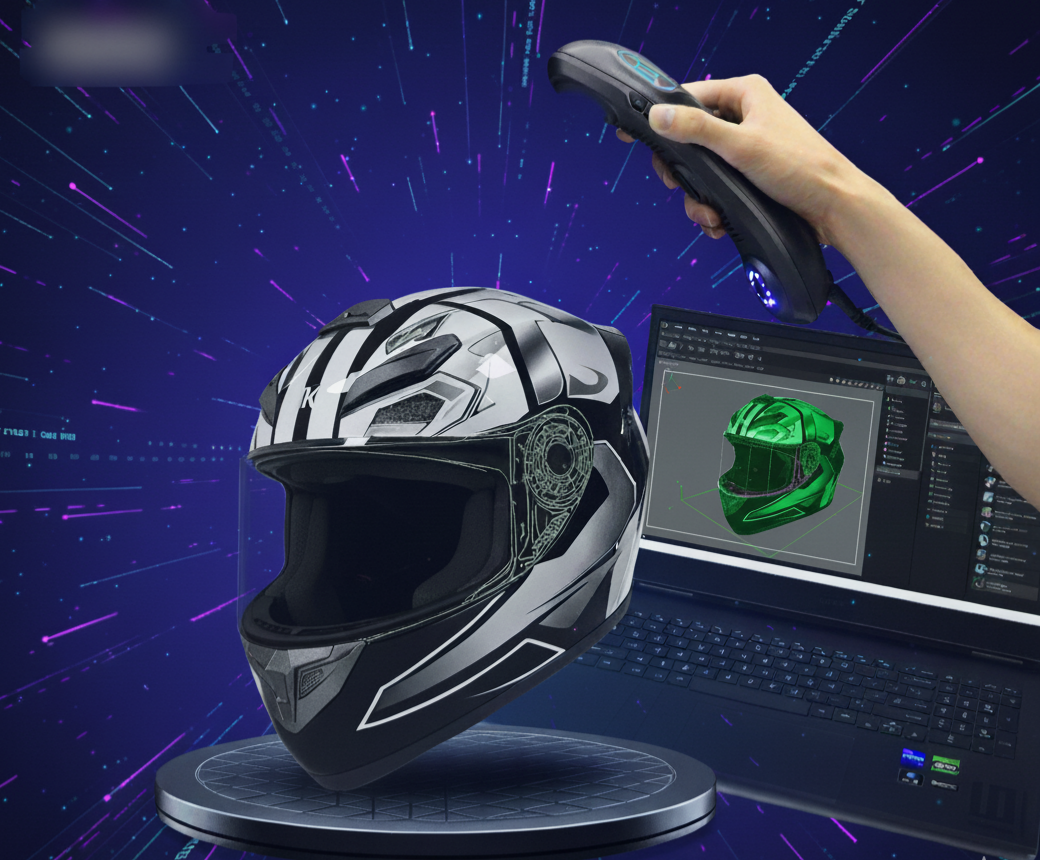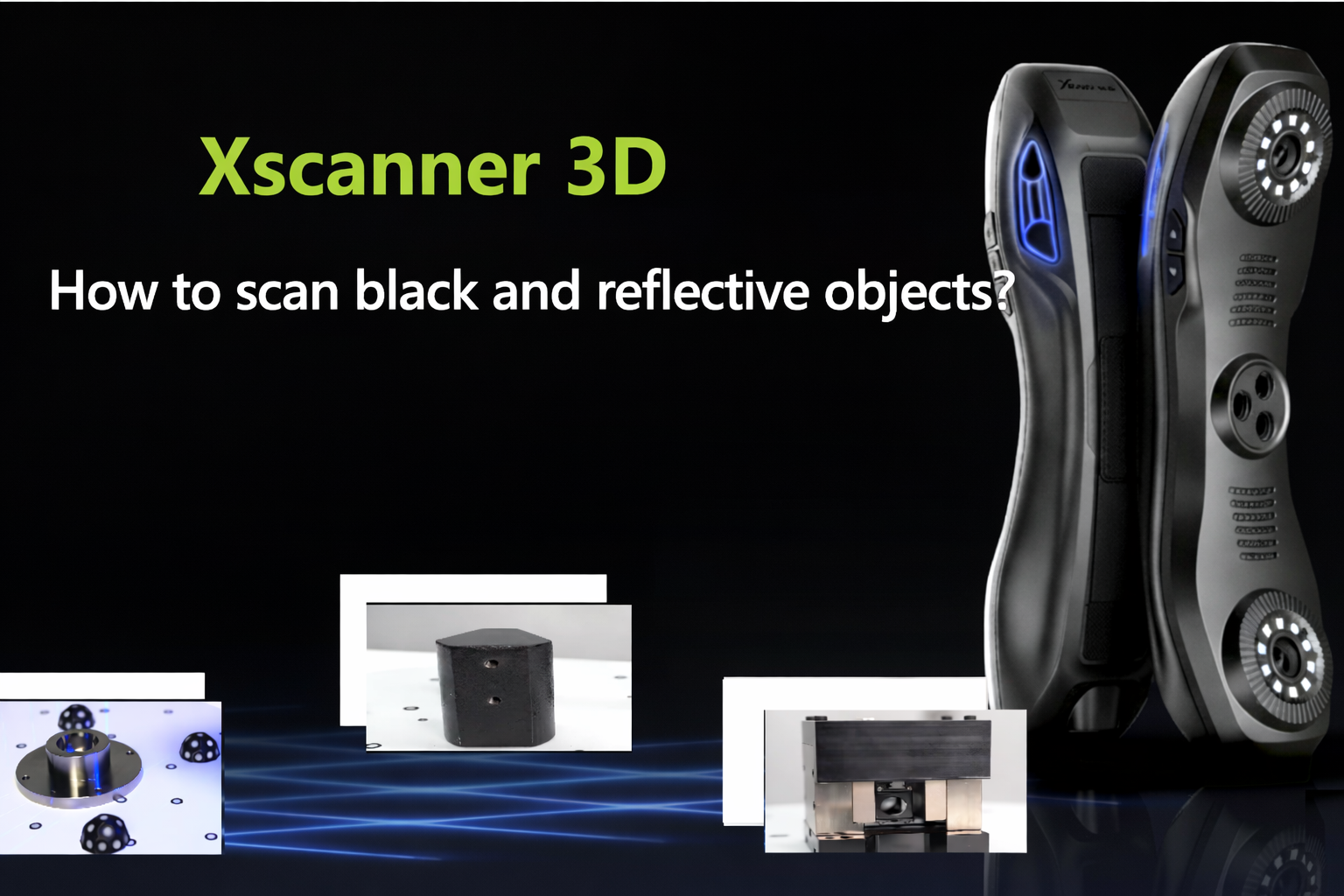
In practical 3D scanning applications, objects made of different materials often bring different challenges to the scanning process.
In particular, highly reflective surfaces and black objects often cause issues such as noise and missing details during scanning, which can be frustrating for many users in real-world operation.
So, how can these types of objects be scanned more effectively?
In this issue, we will briefly explain these common problems.
◆ Common Scanning Challenges
When performing 3D scanning, some special material surfaces can have a noticeable impact on the scanning results, such as:
① Reflective Objects
Materials such as metal usually have strong reflective properties. If curved surfaces or holes are also present, data distortion is likely to occur during scanning, which can affect the stability of the model data.
② Black Objects
Black or dark-colored object surfaces have low reflectivity and absorb light more strongly, making it more difficult for the scanner to obtain stable point cloud data.
As a result, detail loss or incomplete data may occur during scanning.
③ Objects with Complex Materials
In actual scanning scenarios, some objects may simultaneously include reflective surfaces, black areas, and different structural features.
If fixed parameters are used for scanning, they can often only adapt to one type of material. Frequently switching between different parameter modes is not only time-consuming, but can also easily lead to scan misalignment.
Therefore, it is necessary to adopt suitable scanning approaches according to the characteristics of different materials.
◆ Scanning Approaches for Different Materials
For different material surfaces, appropriate adjustments can be made during the scanning process by combining device functions with software settings.
✔ Scanning Highly Reflective Surfaces
By reasonably adjusting scanner parameters, and appropriately increasing the laser angle and exposure time, it is possible to balance the reflection between highlight areas and shadow areas.
This can reduce distortion caused by reflection to a certain extent and make the scanning result more stable.
✔ Scanning Black Objects
When scanning black or dark-colored materials, the laser brightness and exposure time can be appropriately increased to enhance surface reflection, allowing the scanner to receive more light signals.
At the same time, optimization can be carried out by combining device parameter settings with software functions, so as to better capture object details.
✔ Scanning Complex Objects
For objects that have both reflective materials and black areas, while also containing multiple structures, the adaptive scanning function can be enabled.
This function can analyze the surface characteristics of the object and automatically adjust scanning parameters, thereby making the scanning of multiple materials smoother.
◆ Summary
Overall, although the scanning methods for different materials vary, the core idea is the same:
The key is to control the reflection on the object surface so that the scanner can capture clear and stable signals.
During the actual scanning process, reasonably adjusting parameters or using relevant functions according to material characteristics can usually make the scanning process smoother, while also helping improve the data quality of the final model.