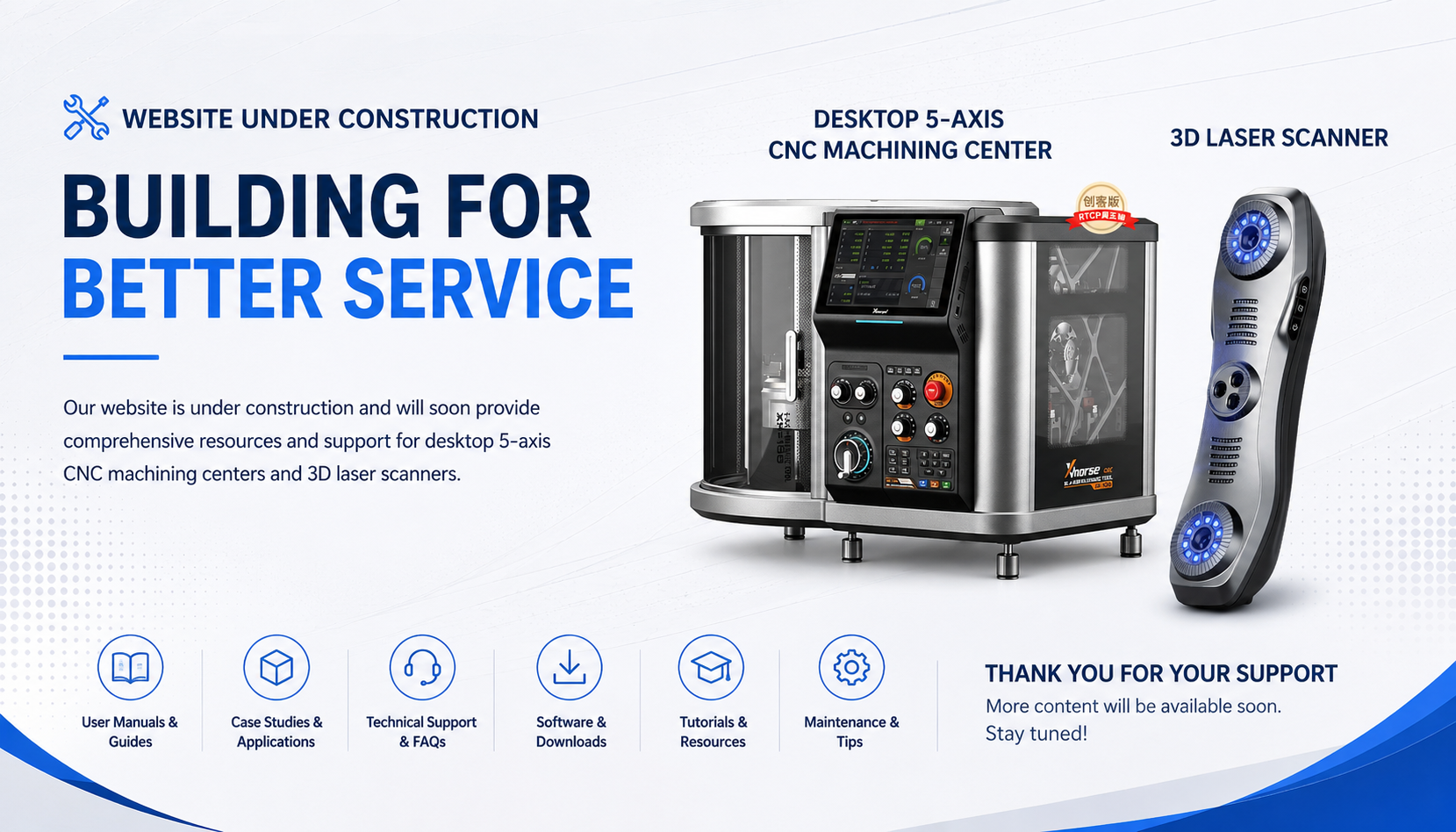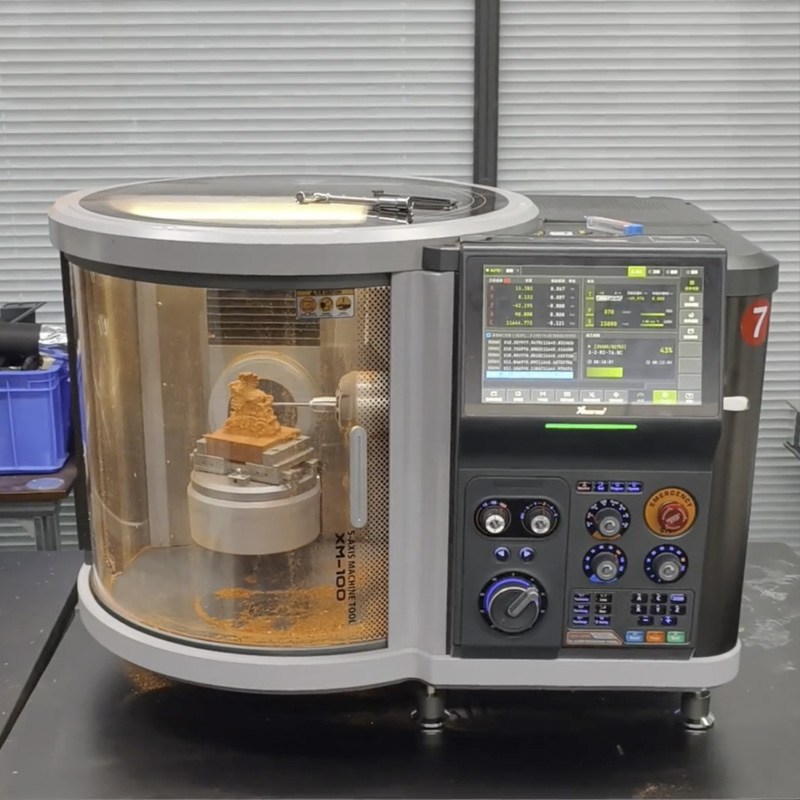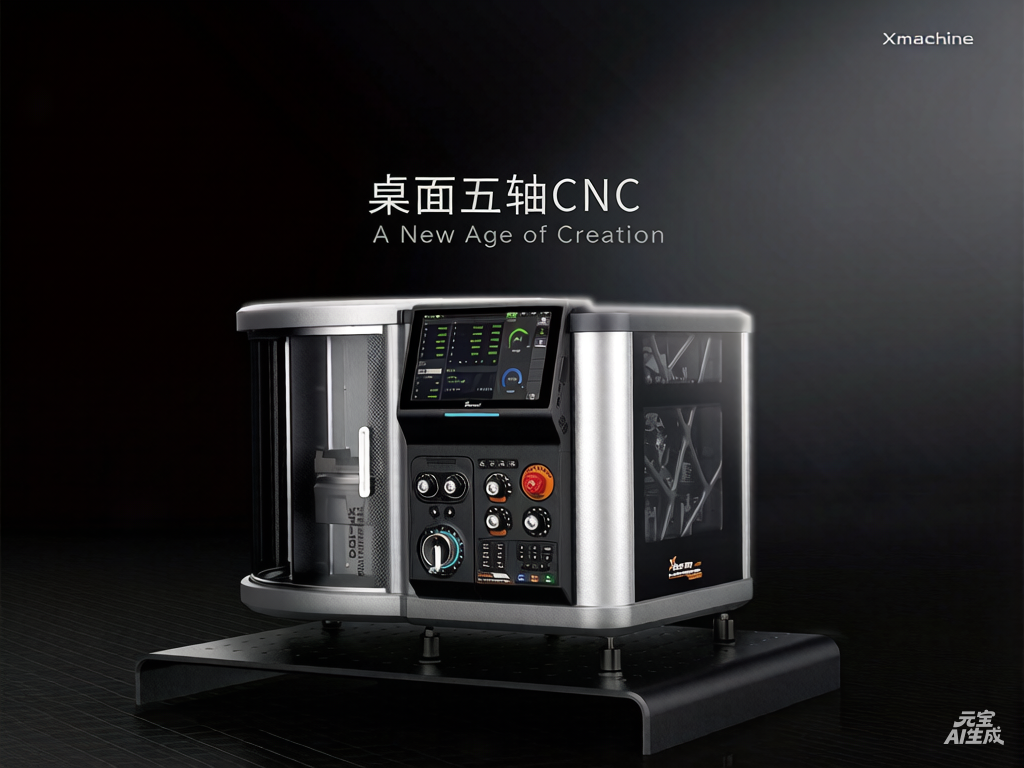
The Xmachine XM-100 you mentioned is a benchmark product in this field. In essence, it is a "precision manufacturing tool" that compresses a factory-grade 5-axis machining center, which typically weighs several tons, down to the size of an office desk. For engineers, makers, or designers, its greatest value lies in eliminating the need for outsourcing—allowing you to obtain high-precision metal/complex material parts directly on your desktop, truly achieving a closed loop from "design" to "finished product."
I. Why is the Xmachine XM-100 a "Game Changer"?
Compared to traditional 3-axis desktop machines or 3D printing, the core advantages of the Xmachine lie in the integration of "True 5-Axis" capability and "Industrial-Grade" automation.
| Core Advantage | Technical Explanation | Practical Value Delivered |
|---|---|---|
| True 5-Axis Linkage (RTCP) | The self-developed system supports Tool Center Point Control. The A/C axes coordinate with XYZ motion to handle complex surfaces. | Complete multi-sided machining in a single setup. Avoids repeated workpiece clamping/unclamping and cumulative errors. Ideal for complex geometries like impellers or sculptural forms. |
| Hidden Automatic Tool Changer (6 tools) | Features an industry-first hidden tool changer for desktops. It retracts during machining and deploys for tool changes. | Enables unattended operation. Automatic switching between roughing (large tool) and finishing (small tool) significantly improves efficiency for continuous machining of complex parts. |
| Fully Automated Measurement System | Equipped with a high-precision wireless probe for automatic workpiece centering and axis calibration. | Turns "craftsmanship" into a "standardized process." Completes error diagnosis and compensation automatically within 5 minutes, reducing reliance on operator experience. |
| Desktop Footprint | The entire machine weighs approximately 130 kg, with dimensions around 800×600×580 mm, and runs on standard 220V power. | Breaks spatial limitations. Can be deployed directly in labs, studios, or even home environments without the need for a dedicated workshop or industrial three-phase power. Key Performance Parameters: |
- Travel: X/Y/Z axes: 156/203/125 mm respectively. Maximum workpiece size: 100×100×100 mm.
- Precision: Tool setter accuracy ≤5 μm.
- The A-axis (-30° to 110°) uses a harmonic drive, and the C-axis uses direct drive, ensuring high repeatability.
- Materials: Capable of stably machining not only plastics but also soft metals like aluminum, copper, and brass, as well as wood, acrylic, wax models, etc.
II. The Ultimate Experience: From "Blank" to "Finished Product"
Returning to your initial reflection on "comparing the blank to the finished product," the technical satisfaction brought by the Xmachine manifests mainly on three levels:
- Leap in Complexity: Traditional 3-axis machines can only perform "relief" carving or simple contours, whereas 5-axis linkage can machine undercuts, deep cavities, and overhangs. Watching a block of aluminum transform into a hollow sphere or a precision gearbox is a visually direct enjoyment of this breakthrough in geometric freedom.
- Industrial-Grade Surface Quality: 3D printing often shows layer lines, while CNC is a subtractive manufacturing process. The metal surface cut by the high-speed spindle (20,000 rpm) possesses a natural luster and texture—an "industrial-grade" feel difficult to achieve with additive manufacturing.
- Automation of the Process: Perhaps the most satisfying aspect is that you only need to complete the model design and workpiece setup. The remaining steps—tool setting, tool changing, and multi-face machining—are all performed automatically by the machine. This shift from "manual intervention" to a "fully automated closed loop" greatly enhances the fluency of the creative process.
- III. Application Scenarios and Decision Advice
- If you are: A mechanical engineer (prototype verification), jewelry/art creator (complex surfaces), or university lab (teaching and training).
- Reason for recommendation: It addresses the pain point of manufacturing "small-batch, high-complexity" parts. You no longer need to outsource a small part to a machine shop and wait for weeks; you can iterate quickly right on your desktop.
- Comparison reference: In the desktop CNC field, the Xmachine occupies a high-end flagship position.If your budget is limited and you only need simple 2D cutting, you might consider entry-level 3-axis machines costing a few thousand RMB. However, if you seek 5-axis linkage and metal machining capability, it is currently one of the very few desktop-grade options with industrial pedigree.
One-sentence summary: The Xmachine XM-100 brings "manufacturing" back to the individual. It is not just a tool but a "desktop factory" that transforms complex designs from virtual models into high-precision physical objects.