In fields such as product design, manufacturing, and repair reproduction, reverse engineering has become an increasingly common technical method.
By using a 3D scanner to obtain physical object data and then carrying out 3D modeling, physical items can be quickly transformed into digital models, greatly improving work efficiency.
Below, combined with practical applications, is a brief introduction to the advantages and operation process of using a 3D scanner in reverse engineering.
I. Advantages of Using a 3D Scanner for Reverse Engineering
⚡Efficiency
3D scanning can quickly obtain product design information and significantly shorten the development cycle.
Traditional manual measurement and modeling often take days or even weeks, while through 3D scanning + reverse modeling, many projects can be compressed to completion within hours, greatly accelerating the speed of R&D and production implementation.
For example, in the automotive parts industry, when performing reverse engineering and inspection of sheet metal parts, a handheld 3D laser scanner can quickly obtain complete 3D data, with fast scanning speed and high accuracy.
👉Accuracy
3D scanning can achieve data capture with micron-level to millimeter-level accuracy, fully preserving product details.
Compared with manual measurement methods, it can effectively avoid:
missed measurements, incorrect measurements, data deviation
At the same time, it can also detect the differences between the actual workpiece and the original drawings through data comparison, quickly identify machining errors, and provide a reliable basis for model correction.
🎯Adaptability
When dealing with complex structures or irregular parts, 3D scanning has obvious advantages.
a. Non-contact data capture, which will not damage the workpiece
b. Able to obtain complete point cloud data
c. Not limited by structural complexity
For some old equipment or products without drawings, scanning can also be used for digital archiving, providing basic data for subsequent maintenance or reproduction.
II. The Operation Is Actually Not Complicated
Many people think that 3D scanning and reverse modeling are relatively complicated to operate, but the actual process is not cumbersome and can generally be divided into the following three steps:
1️⃣Scan to collect data
Place the object to be scanned in a suitable position, and then use a 3D scanner to scan it.
For example, a statue can be placed on a turntable for scanning, while parts such as automotive sheet metal parts can complete data collection by attaching marker points.
2️⃣Simple data processing
After the scanning is completed, perform simple processing on the obtained 3D data, such as removing unnecessary impurities, to make the model data more complete and clear.
3️⃣Carry out reverse modeling
Model based on the scanned data, repair the required parts or adjust dimensions, and finally generate a 3D model in a universal format, realizing the conversion from a physical object to a digital model.
III. Today’s Case Sharing
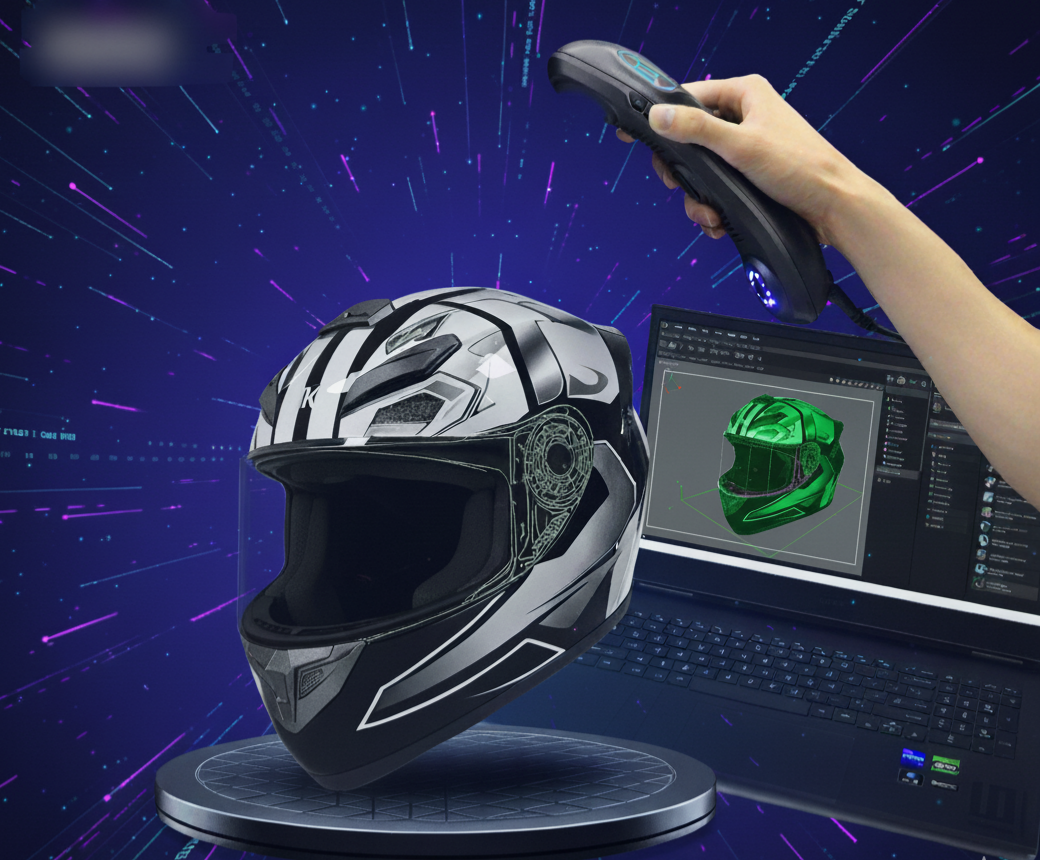
Use a 3D laser scanner to obtain a 3D helmet model through reverse engineering.
The whole process is not complicated: no complex adjustment is required, just pick it up and scan, and the data acquisition is fast and accurate
Even users who have just started with 3D scanning can get started relatively quickly and complete the modeling.
Using a 3D scanner for reverse engineering can obtain product 3D data more quickly, while also being more reliable in terms of accuracy and detail restoration. For workpieces with complex structures, products without drawings, or parts that require inspection and comparison, this method is more efficient and practical.
From scan collection to data processing, and then to reverse modeling, the overall process is relatively clear and simple. Through 3D scanning technology, it is more convenient to complete the conversion from a physical object to a digital model and improve work efficiency.
3D Scanner Helmet Modeling Case Study: Easily Turning a Physical Object into a Digital Model
2026-03-06
473 views
Related articles
Website Under Construction
26-05-26 11:06
373
What are the Application Areas of Desktop Five-Axis CNC Machining Centers?
26-04-24 02:49
570
Desktop 5-Axis CNC: When Industrial-Grade Precision Meets a "Desktop" Experience
26-04-16 06:08
535
How to Scan Reflective and Black Materials? Explanation of Common Issues in 3D Scanning
26-03-07 03:27
578